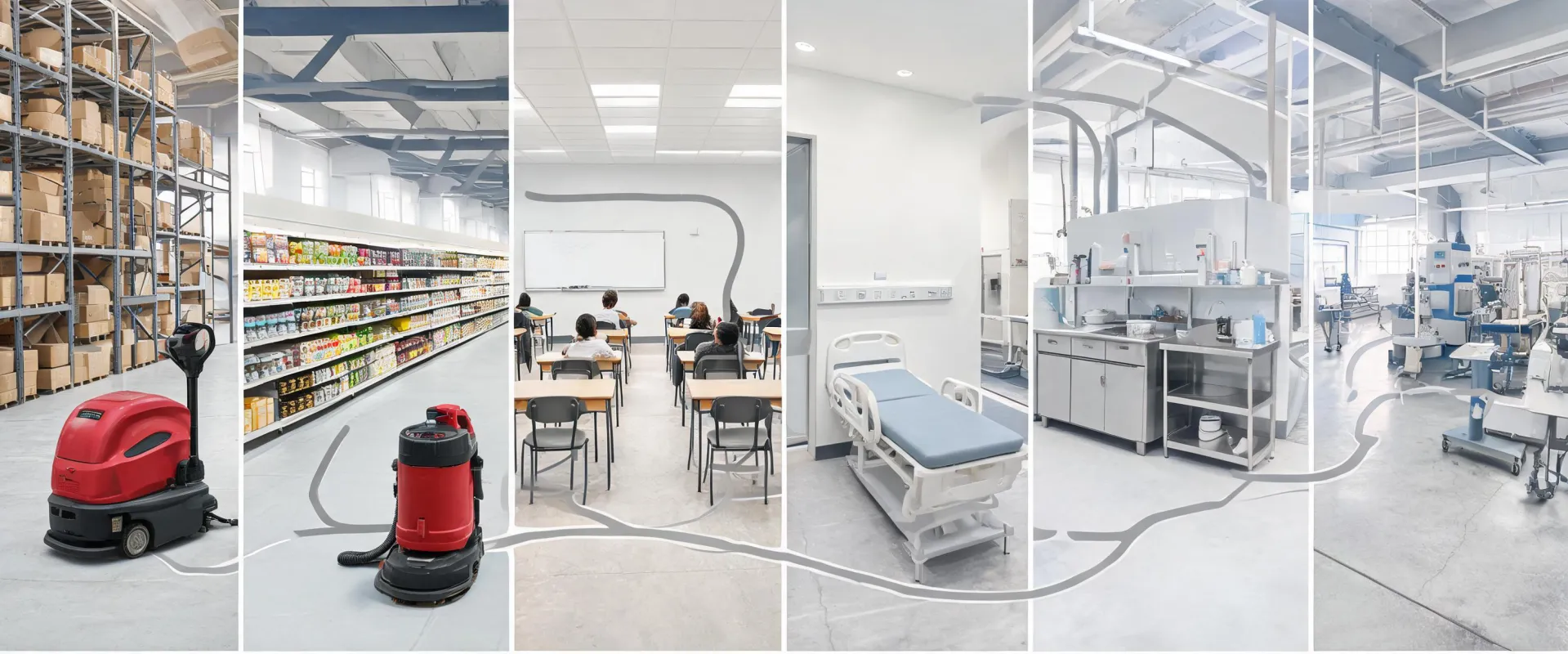
Where we clean
Numatic planning for different facility routes
The same floor-care category behaves differently when the route changes. Map access, soil, pedestrian interfaces, hygiene procedure, available time and disposal points before comparing equipment.
Facility map
Choose the operating environment, then inspect the route
These tabs group common application conditions. They do not assert suitability for a particular model; current technical documentation and a controlled site review remain necessary.
Warehousing and distribution
Long aisles can favour productive straight passes, while rack ends, dock transitions and pedestrian crossings reduce theoretical coverage. Loose debris, tyre marks and pallet fragments may require a defined pre-sweep or vacuum step before wet scrubbing.
Measure cleanable area rather than gross building area. Record the narrowest turn, door threshold, slope, refill distance and disposal route. During a trial, separate setup, active cleaning, refill or dump travel, edge work and final machine care.
Retail, education and municipal spaces
Public opening times, noise sensitivity, lift access, furniture and frequent turns often matter as much as nominal working width. Finished floors also require a conservative pad, brush and chemistry decision based on the surface-care procedure.
Run a trial before opening or inside an agreed control zone. Note manoeuvring, edge access, visible residue, pickup at joints and the surface appearance after drying. A compact machine may be easier to route, but a smaller tank can increase refill travel; both effects belong in the comparison.
Healthcare, food operations and manufacturing
These environments can add controlled procedures, cross-contamination rules, production interfaces, fine debris or occasional liquid pickup. Equipment choice must sit inside the site's risk assessment, hygiene method and approved chemical or electrical practice.
Separate tasks that need different tools. Define the pickup material, disposal method, floor sensitivity and any filtration, antistatic or electrical requirement. This website does not infer specialist compliance from a general Numatic product family; obtain the relevant model evidence.
Map one real route
Ask Numatic with facility evidence attached
Describe the area, floor, soil, tightest access, time window and water or disposal path. If a specialist procedure applies, identify it without assuming a general machine category meets it.
- Request current model documentation.
- Agree a test boundary and method.
- Record limitations as well as acceptable results.